Bademjan
The AI-Native Neobank of Iran
Financing the Persian Renaissance through structured capital, synthetic credit, and financial inclusion for 85 million citizens.
Scroll
I — Introduction
550 BCE
The Persian empire emerged on the world stage with the leadership of Cyrus the Great.
Sixty years later, his successor Darius spread the empire across three continents, reaching 5.5 million square kilometers and encompassing around half of the world’s population. The Iranian nation formed in a crucible of scorching deserts and volcanic mountains, rising from peripheral nascency to overtake the birthplaces of civilization — both Egypt and Mesopotamia.
Throughout Iran’s tumultuous past, it has repeatedly sought to restore this triumphant legacy. Empires stretching from Europe to India rose and fell; their capitals, culture, and canon cultivated Persian civilization. To this day, the people hold pride in their past, and the shared history binds many modern nations together in a web of modern satrapies.
Iran is yet again in the crucible.
The economy lays at the brink of collapse due to global isolation and mismanaged policy, foreign countries claimed aerial supremacy over the country in mere days, and the average citizen struggles for water and electricity.
Yet all around it, neighbors bloom like flowers in the royal Golestan. Azerbaijan has emerged as a commercial crossroads and strategic ally, flush with energy wealth and foreign capital. Iraqi Kurdistan, increasingly autonomous, opens its doors to Western investors and culture alike. The conditions for Iran’s reentry into the global economy are forming on every border.
Iran’s current state is temporary, and it will face an impending period of renewal characterized by realignment and global entrance. The renewed Iran, like it has so many times in history, will shock the world order and become a civilizational superpower.
Iran’s cities will grow higher than Dubai, its businesses will usurp multinational corporations, its resources will reorient the world economy towards the Middle East, and its citizens will achieve breakthroughs in science and technology. It will do so not in opposition to these neighboring states, but as a unified regional cohort.
Bademjan bank, the Perso-Neighborhood Neobank, will guide the Middle Corridor towards its economic potential, providing ordinary citizens with capital and opportunity.
The project positions the Middle Corridor towards sustainable development aligned with all of its citizens. It effectively sets the stabilization framework for the region’s rise and binds it together with global capital institutions.
Much like bademjan serves as a foundation for the kashk, this neobank will become the backbone of the rising Persian economy.
II — Background
The Neobank Revolution
Fintechs, neobanks, and superapps have been extremely effective business models in emerging economies. From SMS banking in Africa, to sprawling payment ecosystems in China, to India’s UPI, fintech innovation has created stable building blocks for economic development.
By the mid-2010s, a new generation of digital-first neobanks emerged. Without physical branch infrastructure, they created a tech-focused model that scales extremely well and disrupts traditional banking players.
Nubank
Brazil & Mexico
Launched no-fee credit cards and app-based accounts against historically high-fee institutional banks, growing into one of the most successful businesses in Latin America.
Revolut
United Kingdom
Spread from a simple FX app into a titan of digital banking in over 100 countries, wielding crypto, stock trading, commercial accounts, and numerous banking licenses.
MNT-Halan
Egypt
Created a financing tool for microentrepreneurs and tuktuk drivers, then grew into the country’s main private provider of digital loans, payments, and consumer finance to underserved populations.
Revenue Streams
Net Interest Income
PrimaryPersonal loans, microfinance, credit cards, overdrafts, BNPL, SME working capital, asset-backed lending, student refinancing, mortgages & auto loans.
Fees & Commissions
Interchange revenue, subscription fees, late fees, merchant processing, loan origination fees.
FX & Trading
Foreign exchange spreads on currency conversions, commissions from insurance, investments, crypto trading, and wealth products.
Reserve Income
Excess capital invested in bonds and interbank deposits. Nubank sourced 33% of its revenue from this stream alone.
Scale Advantages
No branch networks
No legacy IT systems
Front-loaded fixed costs
AI underwriting & fraud
Once compliance and backend software are built, neobanks add incremental users at low marginal cost. Long-term profitability depends on effective underwriting, balanced revenue streams, and lowering acquisition costs relative to lifetime value.
The Moat: Banking License
A banking license allows deposits, loans, and net interest income — services difficult for competitors to replicate by law. Regulators are slow to grant new ones, the approval process is costly, and customers prefer licensed banks for safety and deposit protection.
REVOLUT
Applied via Lithuania → EU deposits & lending expansion
NUBANK
Full Brazilian license → digital savings & personal loans
The Future: AI-Native
With the entrance of agentic AI, future neobanks will look drastically different. Customers may navigate the entire bank through LLM agents — obtaining loans and checking services through chat or voice.
The bank interface could morph into whatever the user needs: financial education platform, health dashboard, or instant credit calculator. The possibilities for innovative user experience have yet to be fully embraced. Bademjan intends to be the first to do so.
Iran: The Rising Lion
Population: 92,417,681
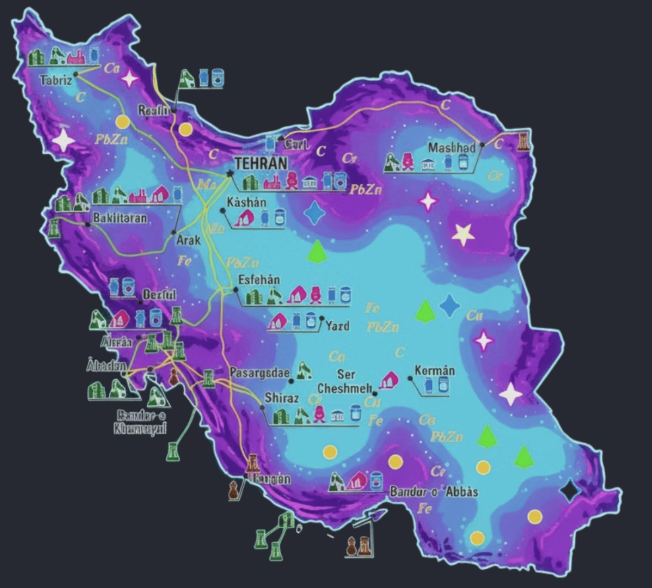
The Arbitrage of the Century
When regime change occurs, the delta between “flailing Autarky” and “global Goliath” creates immense opportunity. This transition moment represents the largest wealth unlock in modern history.
Bademjan will be the first foreign-backed consumer capitalizer to market.
Expanding Access to Credit
Without credit or loan history, traditional banks struggle to allow Iranians to capitalize on their potential. With reliable credit scores after a simple online form, Bademjan implements advanced ML to determine creditworthiness.
- ◆ML models train on emerging market proxies
- ◆Outlier synthetic data generation for resilience to future uncertainty
- ◆Progressive trust building through micro-transactions

Unlocking Iran’s Digital Economy
“Its cities will grow higher than Dubai, its businesses will usurp multinational corporations, its resources will reorient the world economy towards the Middle East, and its citizens will achieve breakthroughs in science and technology.”
Structured support. Capital injections. Thoughtful value creation.
The microfinance backbone of the new consumer economy.